Design
 App Development
 Web Engineering
 AI Services
 Cloud
Cloud Staffing
 Startups
 Health / Fitness
 Education
 Social
 Nonprofit
 Fintech
 Construction
 Logistics
 Government
 Travel/Hospitality
 HR Software
 About Simpalm
 Our News
 Client Testimonials
 Careers
 Our Blog
 Awards
 Resources
 Information
If you have a new app idea that’s waiting to go live in 2026, you might also be wondering about the overall cost you will have to pay to build your app. Overall cost of developing an app depends on diverse factors, including the project complexity, tech stack, design, platform, developer location, and more.
Whether you are a founder, an established business owner, or a product head, this article will guide you on the overall cost of building an app and how to estimate the pricing. Beyond that, you will also learn how to optimize your app development cost without losing out on quality.
Average Mobile App Development Cost in 2026
Average cost of the app depends upon how big and complex the app is. To make it easier for you to understand the cost of the app, we did a survey with multiple app developers and created a cost range based upon the size of the app. Here’s an approximate app development cost breakdown based on the size of app that we received from various surveys:
| Size of the App | Estimated cost range |
| Small Size App | $25k-$75K |
| Mid-Size App | $75K-$200K |
| Large App | $200K- $450K |
| Enterprise Level App | $450K + |
This table will give you a high-level overview of the cost range based upon how big the app is. You will see a big spread in the cost range, this spread is because of various factors like, location, features, interfaces, size and complexity of the app. Throughout this blog, we will show you how to determine the cost of your app based upon various parameters.
Lets Start with the Master Formula
Here is a master equation that you can use to calculate the cost of the app:
Total App Cost = (Planning and Design hours) * Design Rates + (App Development hours + Backend Development Hours + Admin Development Hours+Testing Hours) * Development Rates
- You will need to determine the hours it would take for the design, development and testing of your app.
- You need to estimate the hours it would take to design and development rates for your app.
- Once you have hours and rates, you can multiply them to get the cost. However, determining these numbers is not so easy as they vary a lot.
- The planning and designing phase of an app development project will take around 40 to 300 hours.
- The development phase will take around 150 to 3000 hours.
- The rates can vary from $30/hour to $150/ hour depending on the location of the resources.
In the sections below, we will show you can come up with accurate numbers for your project.
Key Factors that Determine the Cost of the App
Here are the key factors that determine the total cost of mobile app development:
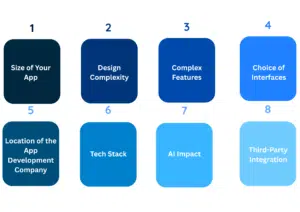
1. Size of Your App
The size of your mobile app is determined based on the screen count, number of features, and complexity. You need to determine how many unique screens and how many functions you have in the app.
- Look for unique screens and count total number of unique screens,
- Look for unique functions, for example: login, ability to make a post, ability to chat, home feed, each would be a unique function.
- Once you count, you can use this table to estimate the size of your app.
| Small Size App | App screens 5-10, basic features like login, and do one-two functions. |
| Mid-Size App | from 12-25 screens, 6-12 main functions in the app. |
| Large App | 25+ screens, 12-20 main functions of the app. The targeted audience is large. |
| Enterprise App | 25+ screens, 20+ main functions. |
2. Design Complexity
Complexity in app design will significantly inflate the overall cost of development as it increases the hours required for crafting the UI/UX, frontend integrations, and custom animations. Some of the complex design aspects that contribute to the overall cost of development are:
-
User Flow:
With more user journeys and more user flows, complex navigation, and multiple screens, the overall development hours will increase, and so will the cost.
-
Linear vs. Non-Linear Design:
Linear designs are simple and cheaper to build, whereas non-linear design consists of dynamic structures and user-driven components, which add to the backend effort and cost.
-
Objective vs. Subjective Design:
Objective design is considered data-driven, which will help you save money by preventing unwanted changes. On the other hand, subjective design is more opinion-based, which leads to expensive redesigns or iterations.
-
Complex Design Assets:
3D elements, custom graphics, animation, and other such assets will demand more skilled labor, and you might have to increase your app development budget.
| Design Level | Quantity and type of user flows. |
| Basic Design | 3-6 user flows, simple and basic design |
| Mid-level design | 7-14 user flows, a mix of linear and nonlinear user flows. |
| Complex Design | 14+ user flows are more nonlinear than linear user flows. |
| Gamified Design | Multiple user flows, animation, gamification concepts like points, badges, leaderboard, motivational design assets. |
3. Features Complexity
Complex features and advanced functionalities like real-time synchronization, AI/ML support, custom animations, and others can increase the app development cost. Every complex feature you decide to add will require coding, designing, and testing efforts, which will increase the development hours and need for specialized expertise. Thus, the overall cost of app development will be impacted! Here are examples of some complex features that can increase the cost:
- Personalization and AI-driven features.
- AR/VR features
- External hardware integration, like Bluetooth devices and wifi devices.
- Offline features
- Advanced GPS tracking, geofencing
- Advanced data security compliance, like HIPAA and PCI compliance
- Multi-Device Synchronization
4. Choice of Interfaces
The interface you choose for your app will immensely impact the overall cost of development. If you just build the iOS interface, that will cost less, if you build both iOS and Android, it will cost more. If you build a web app interface for the same features that will also increase the cost. Most of the times, people begin with iOS and Android App, web app is not built, specially in the MVP phase.
Beyond the platform or interface, the admin panel also contributes to the total cost of development. Simple apps need a basic admin panel, which will cost less. However, apps that require real-time data, user authentication, role-based access control, analytics, reporting, and other such features will need a bigger admin panel, which will cost more.
| ✅ | Do I need only an iOS App? |
| ✅ | Do I need an iOS and Android App? |
| ✅ | Do I also need a Web App with similar features? |
| ✅ | Do I also need an Admin Panel? |
5. Location of the App development team
The location of the app development company you hire will be the major costing factor for your project. It is because the hourly rates will depend upon the location of the development team. Resources in North America cost the most, whereas resources in Asia will cost the least. Below is a table that shows the hourly rates of the resources based upon the location:
| Location | Rates |
| USA | $120-$200/Hour |
| Blended Shoring | $50-$70/Hour |
| South America | $45-$60/Hour |
| Eastern Europe | $40-$50/Hour |
| South Asia | $25-$40/Hour |
| South East Asia | $20-$30 /Hour |
Here is how timing zones work out with these resources:
- South American resources can work in the USA timezone.
- East European resources are 6-7 hours ahead of US timing, however if they work in their evening shift, the working time will overlap with US timing.
- Resources in Asia have a time difference of 9-10 hours, many of them or OK to work in their night shift, which overlaps with US timings.
A very unique model has emerged in the last 15 years, which is called blended shoring. In this model, most of the client-facing team is based in the USA and the rest of the team is in offshore locations, this provides the best of all the resources and the pricing. 50-60% of the projects in the USA are being built in the blended shoring model these days.
6. Tech Stack
Your tech stack for mobile app development, comprising frameworks, backend tools, databases, and programming languages, will be an important determining factor. Your choice between cross-platform and native development will impact the development cost and maintenance efforts. Sometimes you don’t need a downloadable app, you can just build a progressive web app (PWA) or a Web application, which will code less. The table below shows how tech stack affect the cost of development:
| Native (Swift and Kotlin) |
With native approach, iOS and Android apps need to be coded separately, which increases the cost since you need two separate developers. |
| Cross Platform (ReactNative, Flutter, .Net Mui) |
The cost with cross platform is less than native, but more than other approaches. One programmer is used for both iOS and Android. However, optimization and testing time are needed to make sure it works on all iOS and Android Interfaces. |
| PWA (React, NodeJS, Vue Js) |
Building PWA costs a bit less than the cross platform approach, and it can also work on all smartphones, laptops, and tablet devices. It comes with offline support. You can also download it to your home screen. |
| Web App (React, Node.js, Vue.js) |
Costs similar to PWA, and works primarily on Desktop with mobile support. It does not have offline support. |
| Low Code Platforms (Flutter Flow, Appify, Power App) |
Low-code platforms are used for very specific enterprise applications or sometimes to build a very light MVP app for startups and businesses. |
7. AI Impact
The impact of AI can contribute both ways! AI code generation platforms like Claude, or Codex can can reduce the overall development costs by reducing the development time. The AI-powered development tools can cut down coding time by 30-40%. On the other hand, if you have to implement AI driven features or machine learning capabilities in your app, the cost can go up for development and maintenance.
| AI Code Generation Platform like Claude Code, Copilot, ChatGPT codex | Reduces the cost of app development. |
| Integrating AI and ML platforms like TensorFlow. Sage Maker.. | Increases the cost of app development. |
8. Third-Party Integration
Implementing third-party integrations for your mobile app will increase the total cost of development. This factor is often ignored, however, it can heavily impact the final price.
For instance, third-party integrations such as payment gateways, specialized maps, CRM integration, HR software integrations, and other such features demand extra hours to set up APIs. Alongside that, there will be a recurring licensing fee for the APIs, which will add to the year-on-year maintenance costs.
| Examples of Complex Third-Party Integrations | |
| Ex 1: | Payment integration with Stripe, Authorize.net, or other payment-related integrations. |
| Ex 2: | ERP and HR integration |
| Ex 3: | Enterprise CRM integration, like Salesforce, Dynamics CRM |
| Ex 4: | Healthcare integration, like EHR and Patient portal integration |
| Ex 5: | Fitness integration, like fitnesspal, healthkit, and vital tracking device integrations |
| Ex 6: | Smarthouse Integration |
Estimating the Cost of Each Component of the App Development
In this section we will show you how you can estimate the different components of the app:
1. Discovery and Design Cost
It is very important to do proper research and UI/UX for the application. It does not matter if your app is small or big, this is the most crucial step of app creation. It takes time and money to do discovery and design well, however, it will save you time and cost in the long run if you do it right. By having well-defined UI/UX requirements for the app, you can avoid cost escalation during the development of the project. The design process generally involves three key tasks:
- Do proper market research and competitor research to define the need of the app and also what would make it stand out with the competitors.
- Gather and write down all the requirements and functionality.
- Create the layout and user flow of the app using a wireframe tool.
- Create the Design of the app with correct branding, themes, colors, and fonts.
Here are estimated hours for the design of an app based upon different sizes. The table also shows the cost based upon the location of the resources.
| App Size | Hours Needed | USA Based
$120/hour |
Blended Shoring
$60/hour |
Eastern Europe
$50/hour |
India Based
$30/hour |
| Small App | 80 | $9600 | $4800 | $4000 | $2400 |
| Medium App | 150 | $18,000 | $9000 | $7500 | $4500 |
| Large App | 250 | $30000 | $15000 | $12500 | $7500 |
2. Mobile app development cost
You can build your app using the Native iOS and Native Android Approach. Which is one of the best approaches to build high performing apps. You will need two separate developers to build your app on both iOS and Android platforms. You can use this Table to calculate the estimated time and cost to develop the app for native iOS and native Android.
| App Size | Hours Needed | USA Based
$120/hour |
Blended Shoring
$60/hour |
Eastern Europe
$50/hour |
Asia Based
$30/hour |
| Small App | 400 | $48,000 | $24,000 | $20,000 | $12000 |
| Medium App | 1000 | $120,000 | $60,000 | $50,000 | $30000 |
| Large App | 2000 | $240,000 | $120,000 | $100,000 | $60,000 |
Instead of using a native app development approach, you can also use the cross-platform app development approach to build your app. In this approach, you don’t need two developers to build the iOS and Android app. You can use one developer to build apps for both the platform. Some of the popular cross-platform frameworks available these days are: React Native and Flutter. You may not get performance as good as a native approach, but in many cases, it turns out to be a good option. Time taken to build an app using cross platform approach can be in the range of 70%-75% of the native approach. You can use this Table to calculate the estimated time and cost to develop the app using a cross-platform approach.
| App Size | Hours Needed | USA Based
$120/hour |
Blended Shoring
$60/hour |
Eastern Europe
$50/hour |
Asia Based
$30/hour |
| Small App | ~300 | $36,000 | $18,000 | $15,000 | $9000 |
| Medium App | ~800 | $96,000 | $48,000 | $40,000 | $24,000 |
| Large App | ~1800 | $216,000 | $108,000 | $90,000 | $54,000 |
3. Backend/Admin development Cost
Most of the applications these days do require a backend, typically to be able to save data on a backend server, and to be able to fetch it again for later use. Whether it is a social media app, news app, nutrition app, productivity app, or on-demand app, you will need to build a backend server so that the app can function. You also would need an Admin panel to manage the user data, app data and also view analytics. Cost to build the backend/admin for the app depends upon how small or big is the app. You can use the following table to estimate the cost of backend/admin development for an app.
| App Size | Hours Needed | USA Based
$120/hour |
Blended Shoring
$60/hour |
Eastern Europe
$50/hour |
India Based
$30/hour |
| Small App | ~160 | $19,200 | $9600 | $8000 | $4800 |
| Medium App | ~400 | $48,000 | $24,000 | $20,000 | $1200 |
| Large App | ~1000 | $120,000 | $60,000 | $50,000 | $30,000 |
4. Post production cost
Once you launch the apps on stores, you may incur several additional costs. The post-production cost, associated with app development, typically ranges from 10-15% of the initial development cost annually. It means that if an app is built for $100,000, the average post-production cost will be around $10,000 to $15,000 per year. This table shows the different costs associated with post production support and maintenance
| Post-Production Tasks | Average Associated Costs |
| Server Hosting | $50 to $300 for simple apps, $300 to $1,500 for moderate apps, $2000+ per month for enterprise-grade apps |
| Bug Fixes | 3-4% of the initial development cost. |
| OS Upgrades | 1-2 % of the initial development cost. |
| Marketplace Fees | Apple’s App Store charges a recurring fee of $99/year. Also, Google Play Store charges a one-time fee of $25. |
|
Feature Enhancements
|
5-6 % of the initial development cost.
|
Note– $50 to $500/month will be third-party API Subscription fees depending upon the third party platforms and number of calls made.
Estimated cost breakdown for a Small App
This table shows the cost of various components of a small size app based upon the location. It can range from $25-$75K.
| Components | Onshore | Blended Shoring | Eastern Europe | Asia |
| Design | $9600 | $8,000 | $4000 | $2400 |
| Mobile App | $45,000 | $24,000 | $20,000 | $12,000 |
| Backend/Admin | $20,000 | $18,000 | $15,000 | $9,000 |
| Total | $75,000 | $50,000 | $29,000 | $23,400 |
A medium app is the one, which has around 10-25 unique screens. This table shows the estimated cost of a medium app based upon the location of the team. For building a mid-scale or medium-complexity mobile app, you might have to pay around $60,000 to $250,000, with a development timeline of 4 to 8 months. Here’s a detailed breakdown of all the components and their associated costs that contribute to the total expense of building a medium-complexity app:
| Components | Onshore | Blended Shoring | Eastern Europe | Asia |
| Design | $18,000 | $15,000 | $7500 | $4500 |
| Mobile App | $120,000 | $60,000 | $50,000 | $30,000 |
| Backend/Admin | $96,000 | $48,000 | $40,000 | $24,000 |
| Total | $234,000 | $123,000 | $97,500 | $58,500 |
Estimated cost breakdown for a Large App
A large app is the one, which has around 25-40+ unique screens. This table shows the estimated cost of a large app based upon the location of the team.
| Components | Onshore | Blended Shoring | Eastern Europe | Asia |
| Design | $30000 | $25,000 | $12500 | $7500 |
| Mobile App | $240,000 | $120,000 | $100,000 | $60,000 |
| Backend/Admin | $216,000 | $108,000 | $90,000 | $54,000 |
| Total | $486,000 | $253,000 | $202,500 | $121,500 |
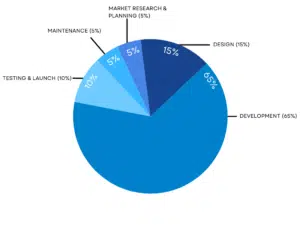
How much should be allocated to each phase of the App SDLC
When you are planning for the budget spending for your app, you should also know how much of cost should be allocated to each phase of the Software Development Lifecycle of the project. This can help you manage your cash as you execute the project. This table shows the cost breakdown:
| App SDLC Phase | Cost Percentage Breakdown |
| Product Discovery & Planning | 5% to 7% of the total development cost |
| UI/UX Design (Wireframing and Prototyping) | 10% to 15% of the total development cost |
| Frontend & Backend Development (Coding, API Integrations, Database Setup) | 50% to 70% of the total development cost |
| QA Testing and Performance Improvements | 10% to 15% of the total development cost |
| Deployment (App Store/Play Store Submission, Cloud Configuration, CI/CD Setup) | 2% to 3% of the total development cost |
For post production support and maintenance, you should plan around 10-15% of the app development cost for the first year of maintenance after the app has been launched. |
|
Many businesses jump into building apps without having a thorough understanding of all the involved costs in developing one. So far, this article has covered the obvious expenses that go into building a mobile app. However, there are some hidden costs that might find their way to your total overall cost of the project, which include:
| Maintenance | All mobile apps require continued maintenance in order to stay relevant with the latest OS versions, backed with security patches and bug fixes. It would cost around 7-10% % of the initial development cost annually. |
| Accessibility Standard Adherence | In order to ensure your mobile app meets the legal accessibility regulations and standards under WCAG, you can expect to pay around $3,000 to $15,000. |
| Security/Regulatory Compliance | Implementing & documenting the compliance for CCPS, HIPAA, or GDPR will cost around $10,000 to $20,000, alongside other technical implementation expenses. |
| Localization | Making your app accessible to a global audience will require you to make it localized for different regions. Professional localization, depending on the cultural adaptations and languages you are targeting for the app, will cost around $5,000 to $30,000. |
| Marketplace Commissions | Apart from Apple’s $99/year and Google’s $25 on-time store fee, both of them charge 15% to 30% of commission on all the subscriptions or in-app purchases, which eventually reduces the net revenue of your business. Brands refer to this cost as “Success Tax”. |
How In-House vs. Outsourcing Affects the Cost of App Development?
For most of the businesses seeking mobile app development, the decision eventually comes down to the best two options, which are:
- Hiring an in-house team
- Partnering with a mobile app development company
Each of these options have their respective implications, and that’s not only the cost! You must assess the technical control, talent exposure, and product velocity you attain for the price that you pay. So, here’s a brief comparison of how in-house vs. outsourcing affects the cost of app development:
| Criteria | In-House App Development | Outsourced Development |
| Team Structure | You will be responsible for hiring and building your entire in-house team to take on the mobile app development project. From initial design to development and post-launch maintenance, everything needs to be handled by your in-house team. | Here, you will be partnering with one of the best mobile app development companies and will hire a skilled team of professionals, readily equipped to get started on your custom app project. External teams have access to the right tools, technologies, and resources to cut down the prolonged knowledge-gathering time and kick-start the project right away. |
| Cost | You will have to pay a salary of around $150,000 to $240,000 for resources to join your team for the app development project. The total cost will also include employee benefits or infrastructure expenses. | You will be paying between $25,000 and $400,00, which is way more reasonable than hiring a full team to fill diverse departments required for designing, developing, testing, and maintaining an app. |
| Speed to Start | It will take around 1 to 2 months for you to hire the in-house team members and get started with your project. | As the team is readily available at your disposal, it will take around 1 to 3 weeks of time to get started with your project. This time is required for conducting market analysis, mapping user journeys, and assessing your requirements. |
| Best For | Core product teams | MVPs, quick launches, cost-sensitive launches, and exploratory development. |
Annual Cost Breakdown of In-House Mobile App Development in USA
For every in-house developer or team member you hire for building your mobile app, the salary is not the only payable amount. In the United States, the average salary of developers starts from $90,000 per year, but there are a lot of other things that contribute to the total payable amount, which include:
| Costing Components | Annual Cost in USD | Description |
| Base Salary | $90,000 to $130,000 | Varies depending on the location and experience of the individual. |
| Employee Benefits and Insurance | $18,000 to $26,000 | This cost covers insurances including dental, vision, health, and life coverage. |
| Payroll Taxes | $10,000 to $15,000 | Medicare, Social Security, and Unemployment taxes |
| Software and Equipment Expenses | $5,000 to $10,000 | This cost includes laptops, monitors, development tools, product licenses, and more. |
| Office Space | $12,000 to $20,000 | Office desk, utilities, and other facilities. |
| Recruitment Costs | $15,000 to $30,000 | Screening, hiring, onboarding, and HR time. |
| Total Annual Cost | $153,000 to $239,000/Developer |
You can see this cost is definitely higher compared to outsourcing the project. In-house hiring works only when you are building a large product and you will be continuously updating it.
MVP Development Cost for Popular Apps
We have talked about so many factors that you need to consider for app cost estimation. To give you a real-world perspective, we have created MVP development costs for some of the popular apps in the market. Here are MVP development costs using blended shoring model for these apps:
| App Name | Type of App | Cost of MVP Development(Blended Shoring Model) |
| Venmo | Peer to Peer | $90,000 to $100,000 |
| Social Networking | $100,000 to $120,000 | |
| Video based Networking | $60,000 to $70,000 | |
| Uber | On-Demand | $120,000 to $150,000 |
| Snapchat | Chatting App | $50,000 to $60,000 |
| Messaging App | $80,000 to $100,000 | |
| YouTube | Video Streaming | $100,000 to $120,000 |
How to Optimize Mobile App Development Costs?
Now that you have a clear insight into the average amount that you have to pay for building your mobile app, let’s now talk about how you can save a few bucks in the process. Here are some of the optimization tips for you to reduce your overall mobile app development costs:
-
Document Your App Requirements
Document your app requirements, such as UI/UX elements, desired platform, and features you need. This way, you and the development team can visualize the end product, which will help in determining the average cost. Moreover, you will also be able to reduce the time and cost required for frequent redesigns.
-
Clearly Define the Features & Scope of Your App
It is important to have a clear vision of the purpose and features of your app, right from the early stages. This is because changing the concept of your project in the middle of the development stage can lead to increased costs and extended timelines. Thus, a properly defined plan will keep an entire team aligned to the project and help manage the budget effectively.
-
Use AI to Reduce the Initial Cost
Seek the developers’ help for utilizing AI in mobile app development and leveraging its potential through rapid prototyping, code automation, and pre-trained ML models. Using AI tools for coding helps reduce the developer hours, which eventually lowers the overall cost of your project.
-
Built an MVP First
If you are a small business or a startup, it is important that you lower your operational costs, especially at the initial stage. Therefore, you can prioritize launching an initial version of the app with only the essential features, which is referred to as an MVP.
This approach will help you save costs, enable you to enter the market faster, gather user feedback, and make future enhancements. With this approach, you can ensure that your investments are being made only on the features that resonate well with the audience.
-
Choose the Right Development Method: Native vs. Cross-Platform
Your development methodology matters immensely when deciding on the overall cost of your project! When you opt for native app development, you are up for obtaining digital products with superior performance.
However, the cost of developing native apps is very high, considering they require separate coding efforts for each OS. On the other hand, cross-platform apps are less expensive as they are built using a single codebase for both iOS and Android platforms. Even though it is faster to build a cross-platform app, there might be some performance shortcomings when compared to native apps.
-
App Development Agency vs. Freelancer
When in a dilemma of whether to hire a freelancer or outsource the entire app development project, you must know that both options have their own set of pros and cons, considering your requirements.
Freelancers might charge a lower overhead when compared to app development agencies, but being cheaper also poses a high risk of project failure if the freelancer becomes unavailable or abandons the task.
Eventually, you might end up spending more to amend or finish the project. Therefore, hiring agencies is a better option as you get contractual guarantees upon the completion and success of your project.
Wrapping Up
App development cost in 2026 varies widely based on complexity, features, and the approach you choose. By clearly defining your requirements and starting with an MVP, you can keep your budget under control. Choosing the right tech stack and partnering with a reliable mobile app development agency like Simpalm can further help you optimize costs without compromising quality. Most importantly, planning for post-launch expenses ensures long-term success and scalability. If you have an app idea and need a more detailed cost estimation, feel free to reach out to us.
FAQs
How long does it take to build an app?
Developing a mobile app will take around 3 to 9 months! To further break the timeline down:
- Building a simple app will take 1 to 3 months
- Medium-complexity apps can be built in 4 to 7 months
- Enterprise-grade apps will be built in around 9 to 18+ months
What factors affect app development cost?
The cost of app development will be majorly impacted by:
- Complexity of the project
- Design requirements
- Platform choice
- Feature requirements
- Development team’s location
- Team expertise
How much does it cost to support and maintain an app?
The average cost to maintain an app is around 10-15% of the initial development cost, on an annual basis. App maintenance covers domains such as bug fixes, support, updates, and server hosting.
Are online app cost calculators accurate?
Yes, the online app cost calculators are accurate for providing you with a rough ballpark estimate. This way, you can start your early-stage budgeting for the project.