
 Design
 App Development
 Web Engineering
 AI Services
 Cloud
Cloud Staffing
 Startups
 Health / Fitness
 Education
 Social
 Nonprofit
 Fintech
 Construction
 Logistics
 Government
 Travel/Hospitality
 HR Software
 About Simpalm
 Our News
 Client Testimonials
 Careers
 Our Blog
 Awards
 Resources
 Information
Building a mobile app sounds exciting – until you realize halfway through that your codebase is a mess, your users are frustrated, and your app crashes more than it runs. Most developers don’t fail because they lack talent. They fail because they skip the fundamentals.
Here are the key stats to know about the mobile app market:
- 6.8B smartphone users worldwide
- 77% users abandon the app within 3 days
- 88% of mobile time is spent in apps
Why Mobile App Development Best Practices Actually Matter
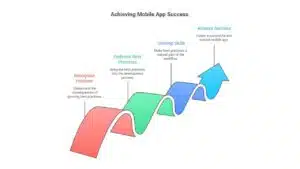
If we’re being honest, best practices often get ignored until there’s a problem. And when that happens, the cost is already paid-a laggy app, poor UX, or a security lapse can drive users away instantly. In today’s crowded app ecosystem, losing trust is hard to recover from.
The upside is that these best practices aren’t difficult to follow. Over time, they become second nature and even speed things up. Let’s break down what actually works in mobile app development best practices, based on real-world experience, not just theory.
1. Plan Before You Write a Single Line of Code
This sounds obvious. And yet, so many developers skip it. They jump straight into building features because planning feels unproductive. But rushing into code without a solid plan is one of the costliest mistakes in app development.
Before you open your IDE, ask yourself a few honest questions. Who is your target user? What problem are you actually solving? What platforms are you building for – iOS, Android, or both? What’s your minimum viable product?
PRO TIP
Write out your user flows before you write a line of code. Paper or whiteboard-it makes no difference. The point is to think through the experience first. You will detect friction points within minutes, as opposed to days to come correcting them.
Also crucial: select your tech stack early. Nativeness vs cross-platform frameworks such as Flutter or React Native is not only a technical option but also defines your whole build. No general answer exists, just the one that applies to your particular product.
2. Prioritize User Experience For Mobile Apps Best Practices
This is a bitter reality: it does not matter how ingenious your code is to the users. They are concerned about the feel of your app. When what you offer is confusing onboarding, or clunky navigation, they will move on – and will likely leave a one-star review on their way out.
Designing with thumbs and not mice is one of the most neglected best practices of mobile apps. Most of the time, mobile users use one hand to interact with the screens. So take the things you need the most, and put them in your easy thumb reach. Use large buttons that are easy to tap.
Key UX Checklist:
- Design for thumb zones – place primary actions in the lower half of the screen
- Use a consistent navigation pattern (bottom nav, tab bar, or drawer – not all three)
- Respect platform conventions – iOS and Android users have different expectations
- Support dark mode and dynamic text sizes for accessibility
- Always show loading states – never let the UI appear frozen
Additionally, accessibility is not optional. It’s not just the right thing to do – it’s also good business. Roughly 15% of the world’s population lives with some form of disability. Accessible apps also tend to score better on app store algorithms.
3. Write Clean, Maintainable Code
You have heard the expression write code for the next programmer. That developer next is, in most cases, you, six months later, looking at a function that you wrote at 2 am, and asking, what the hell was going through your head.
Clean code isn’t about being perfect. It’s about being readable. Use meaningful variable names. Divide big functions into small functions. Adhere to the principle of a single responsibility – a function, class, and a module should do one thing well. In the context of best practices in mobile app development, a modular architecture will pay off as soon as your project is expanded.
Besides, check in version control always. This sounds simple, yet there are numerous solo developers or small teams that use Git as an option. It’s not. Branching systems such as Git Flow or trunk-based development assist teams to work together without having to tread on each other. This way, your release process is smoother and much less stressful.
Architecture Matters in Mobile App Development Best Practices
Patterns like MVVM, MVC, or Clean Architecture aren’t just buzzwords. They separate concerns in a way that makes your code testable, scalable, and easier to hand off. Pick one and stay consistent across your project – mixing patterns halfway through is a recipe for confusion.
4. Security and Performance: Don’t Treat Them as Afterthoughts
Many teams attempt to hurry through this step, and it normally backfires. Security and performance do not come as an add-on. They must be on board at the beginning.
On security, make it simple and stern. Don’t store sensitive data in plain text. Store securely, encrypt all significant data, and authenticate on the client and server sides. Also, outdated dependencies? They’re a real risk. It is more than it appears to be important to keep them informed.
Performance is equally inexorable. Even minimal delays are observed by the users. And one can be too many to lose them. Image optimization, loading of images should be done in batches, and network calls should be made as few as possible. Android Profiler or Xcode Instruments can be used to see where things are slowing. You can also consider to buy mobile proxy server for better optimization.
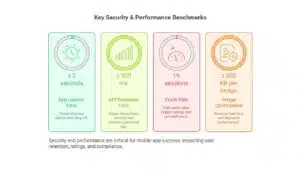
Key Security & Performance Benchmarks
| Metric | Recommended Standard | Why It Matters |
| App Launch Time | ≤ 2 seconds (mid-range devices) | Faster startups reduce user drop-off and improve retention |
| API Response Time | ≤ 300 ms | Keeps interactions smooth and prevents perceived lag |
| Crash Rate | < 1% sessions | High crash rates directly impact ratings and uninstall rates |
| Data Encryption Standard | AES-256 / HTTPS (TLS 1.2+) | Protects sensitive user data and ensures compliance |
| Image Optimization | ≤ 200 KB per image (compressed & cached) | Reduces load time and improves performance on slower networks |
5. Testing – Do It Early, Do It Often
Testing is probably the most skipped part of mobile development. Not because it’s unimportant, but because everything else feels more urgent. Deadlines, features, fixes… testing gets pushed to the end.
But that’s where things get messy. Bugs found late are harder and more expensive to fix. It’s just better to test while building. Write unit tests early, automate important user flows, and run your tests on every code push if you can.
Also, simulators only take you so far. They don’t fully reflect real-world conditions. Things like poor connectivity or device limitations behave differently on actual phones. Having a few real devices to test on-especially ones your users use, helps catch what simulators miss.
Testing Types to Cover
Unit testing (individual functions), integration testing (how modules work together), UI/end-to-end testing (user journeys), and performance testing (load time, memory usage). You don’t need 100% coverage – but your critical paths absolutely need it to follow mobile app development best practices.
6. Launch Smart, Then Iterate Fast

A common trap? Delaying until it feels just right to start. In the majority of instances that only postpones progress. It is better to start with a good basic idea and refine as you progress.
Pre-launch, install such tools as Firebase Crashlytics or Sentry. They will notify you early when there is a snag in the production process- even before the users can even complain. In addition, establish analytics at the earliest. How users actually behave may be quite different from how you imagine them to be.
Maintain momentum after launch. Frequent changes are beneficial to users and the app stores’ ranking. And when individuals post a review, good or bad, reward them. The interaction creates trust in the long run.
Be sure to review your system as things expand. An application that can manage 1,000 users easily may not be able to cope with 100,000. Early consideration of scalability can make a huge difference in the future.
Conclusion
Mobile apps are core business assets that directly impact growth and customer experience. Mobile app development isn’t simple. There’s always something to decide, something to fix, and plenty of ways things can go off track.
But when you look at apps that actually work well, there’s a pattern and best practices behind them. At Simpalm, these best practices are implemented through a structured, agile, and data-driven approach, from product validation to post-launch optimization. This ensures businesses can build secure, scalable, and high-performing applications that are ready to adapt and grow with real-world demand.
The expert team of Simpalm sticks to a result-oriented process and provides the best mobile app development solutions for businesses, startups, nonprofits, and enterprises.